
After 14 years of organizing safaris from Arusha, I can tell you the single most common mistake travelers make. It is not the camera, and it is not the wrong shoes.
It is that people pack for the Africa they imagined, all heat and sun.
Then they arrive on the highlands, where the morning game drive starts at 6 in an open vehicle and the air is cold enough for a proper jacket.
So here is what to take on safari in Tanzania, from someone who lives here and sends people out on the plains every week.
In short: neutral, breathable clothes you can layer, one warm jacket, sun and dust protection, a soft bag that respects the weight limits on light aircraft, and not much else.
The details are below, section by section, and I have kept the lists short so you can pack straight from them. Packing is only one part of getting ready: for the visas, health, money, and local rules, see my guide on things to know before visiting Tanzania.
The one thing most travelers get wrong: layering
The reason you layer in Tanzania is altitude, not distance from the equator.
Most of the northern safari circuit sits high, and temperature drops fast with elevation.
The plains warm up quickly once the sun is up, but the first hours of a game drive can be genuinely cold, and in an open vehicle the wind makes it feel colder still.
Here is the spread across the places you are likely to visit:
| Place | Elevation | Typical range |
|---|---|---|
| Serengeti plains | 1,400 m | 14–29°C |
| Arusha (safari hub) | 1,350 m | 13–28°C |
| Ngorongoro rim | 2,300 m | 8–22°C |
| Zanzibar archipelago | sea level | 25–32°C |
Two numbers matter more than the rest. In an open vehicle it feels 5 to 10°C colder than the still air outside, and at dawn on the plains the temperature can drop below 10°C, especially in June, July, and August.
On the Ngorongoro rim the nights fall below 10°C for much of the year, which makes it the coldest of the major safari spots. That is why layering beats any single “safari outfit.”
You want to start the morning warm and peel down to a shirt by mid-morning, then reverse it after sunset.
Clothing: what to wear on safari
Dress for the day in three parts: a breathable base for the heat, a warm middle for the cold starts, and a light shell for wind and the occasional shower.
Everything in neutral colors. You do not need a specialist safari wardrobe, but you do need the right logic behind it.
Neutral colors
Neutral colors keep you cooler in the sun and blend into the environment, which matters most on foot rather than in a vehicle. Stick to earth tones and leave two color families at home:
- Earth tones to pack: khaki, olive, tan, brown, muted green.
- White to skip, because the dust turns it a dull red within an hour and it never really recovers.
- Bright colors and black to skip, which stand out on a walking safari and, in the case of dark blue and black, are known to attract tsetse flies.
Breathable layers
For the warm part of the day, natural fabrics work best. They breathe, they handle the heat, and they dry fast when you rinse them at the lodge.
- Cotton or linen shirts, a mix of short and long sleeves.
- Lightweight trousers, ideally quick-dry. Long over short, since they double as sun and insect cover.
- A couple of t-shirts for downtime around camp.
Pack light on quantity.
Most lodges and tented camps offer a laundry service, so three or four days of clothing covers a longer trip.
Warmth for early mornings
This is the layer people forget, and the one they end up asking the guide to lend them a blanket for. You want one warm mid-layer and one wind layer, and that combination handles almost everything.
- A fleece or a light down jacket for the pre-dawn cold.
- A windproof shell over it for the open vehicle and for the balloon flight, where you are stationary in cold air until the sun climbs.
- For the Ngorongoro rim specifically, add a warm hat and thin gloves if you are on an early crater descent. It sounds like too much until you are doing it at 6 in the morning at 2,300 meters.
Modest wear for towns and villages
On the coast and in local communities, cover up a little. A light scarf or sarong does the job and packs into nothing. Two simple courtesies:
- Keep shoulders and knees covered in Zanzibar’s Stone Town and in the villages, out of respect.
- Ask before photographing people, always.
Footwear and headwear
You do not need heavy hiking boots for a standard game-drive safari, because you spend most of the day in the vehicle.
You do need closed, comfortable shoes for walking activities and dusty campsites, plus real sun cover for your head.
- Closed walking shoes: sturdy trail runners or light hiking boots, broken in before you travel. Required for any walking safari, where closed shoes are non-negotiable.
- Sandals for the evenings at camp and for Zanzibar. Reef-safe if you plan to be in the water near coral.
- A wide-brimmed hat, not a cap. You want the neck and ears covered, because the equatorial sun is strong and it finds the spots a cap misses.
If you are also climbing Kilimanjaro, that is a different footwear conversation entirely, with insulated boots and a full layer system for a mountain that can go from 30°C to below freezing in a single day. For a game-drive safari, the list above is enough.
Gear and equipment
Bring the things that make the difference in the field, and skip the ones we already carry for you. Our vehicles come with a fridge, cold drinks, binoculars, and an inverter to charge batteries during the drive, so you can plan around that rather than duplicating it.
- Binoculars: worth bringing your own if you have a pair you like, though there is a set in every vehicle. One per person beats sharing.
- Camera and a zoom lens: a 200mm reach or more earns its place. Wildlife rarely poses close, and the difference between a memory and a photo is often the lens.
- A power bank, since a full day out drains phones fast. You can top up in the vehicle, but a bank covers the gaps.
- A plug adapter: Tanzania uses the UK-style type G plug at 230V, so bring the right adapter if your devices are from elsewhere.
- A headlamp or small flashlight, genuinely useful at tented camps and campsites where paths between tents are unlit at night.
One honest note on tented camps.
They have electricity and hot water on demand, and the tents are as large as hotel rooms with a private bathroom, but there is no high-wattage power, so a hairdryer will not work. Plan your gear around charging small devices, not running appliances.
Health and toiletries
Pack a compact kit for sun, dust, and insects, because those three are what actually affect you day to day. Nothing here is exotic, but the equatorial and high-altitude conditions make each one matter more than you would expect at home.
Sun protection
The sun is intense here, and it is stronger again at altitude in Ngorongoro and on the mountains where the thinner air filters less of it.
Three things handle it:
- High-SPF sunscreen, applied and reapplied through the day.
- Proper sunglasses to cut the glare off the plains.
- The wide-brimmed hat from the previous section, which does its real work here.
Dust protection
The dry-season tracks are fine red dust, and an open vehicle sends it everywhere. Three small things make a long, dusty drive far more pleasant.
- A buff or a cotton scarf to pull over your nose and mouth on a dusty stretch.
- Eye drops, because the dust dries your eyes out over a full day.
- Wet wipes, the most useful thing in the whole kit and the one people thank me for later.
Insect protection
Protecting yourself from mosquito bites is the part of the packing list that is about health, not comfort, so it is worth doing properly.
The US Centers for Disease Control and Prevention recommends EPA-registered repellents built on one of five proven ingredients: DEET, picaridin, oil of lemon eucalyptus or PMD, IR3535, or 2-undecanone.
A few practical points from the same guidance.
- DEET works, and its effect plateaus around 50%. Higher concentrations do not add much protection time, and anything under 10% only lasts an hour or two.
- Permethrin goes on clothing, never on skin. Treated shirts, trousers, and mosquito nets repel and kill insects, and the treatment lasts through several washes.
- Cover skin at dusk: long-sleeved shirts and long trousers are the simplest protection, which is another reason those breathable long layers earn their place.
You will need more repellent in the wet season, from November through May, when there are simply more mosquitoes around.
Talk to your doctor about malaria prevention before you travel, since that is medical advice I am not qualified to give.
If you want the practical picture from our side of things, I have written separately about malaria on safari in Tanzania.
Personal medications and basics
Bring what you personally rely on, because a specific brand or prescription can be hard to replace once you are on the circuit.
A small personal kit covers the ordinary things:
- Any regular medication you take, in a small personal supply.
- Basics for headaches, stomach upsets, and blisters.
- Prescriptions kept in your carry-on, not in the checked bag that flies separately on a light aircraft.
Luggage: bags and baggage limits
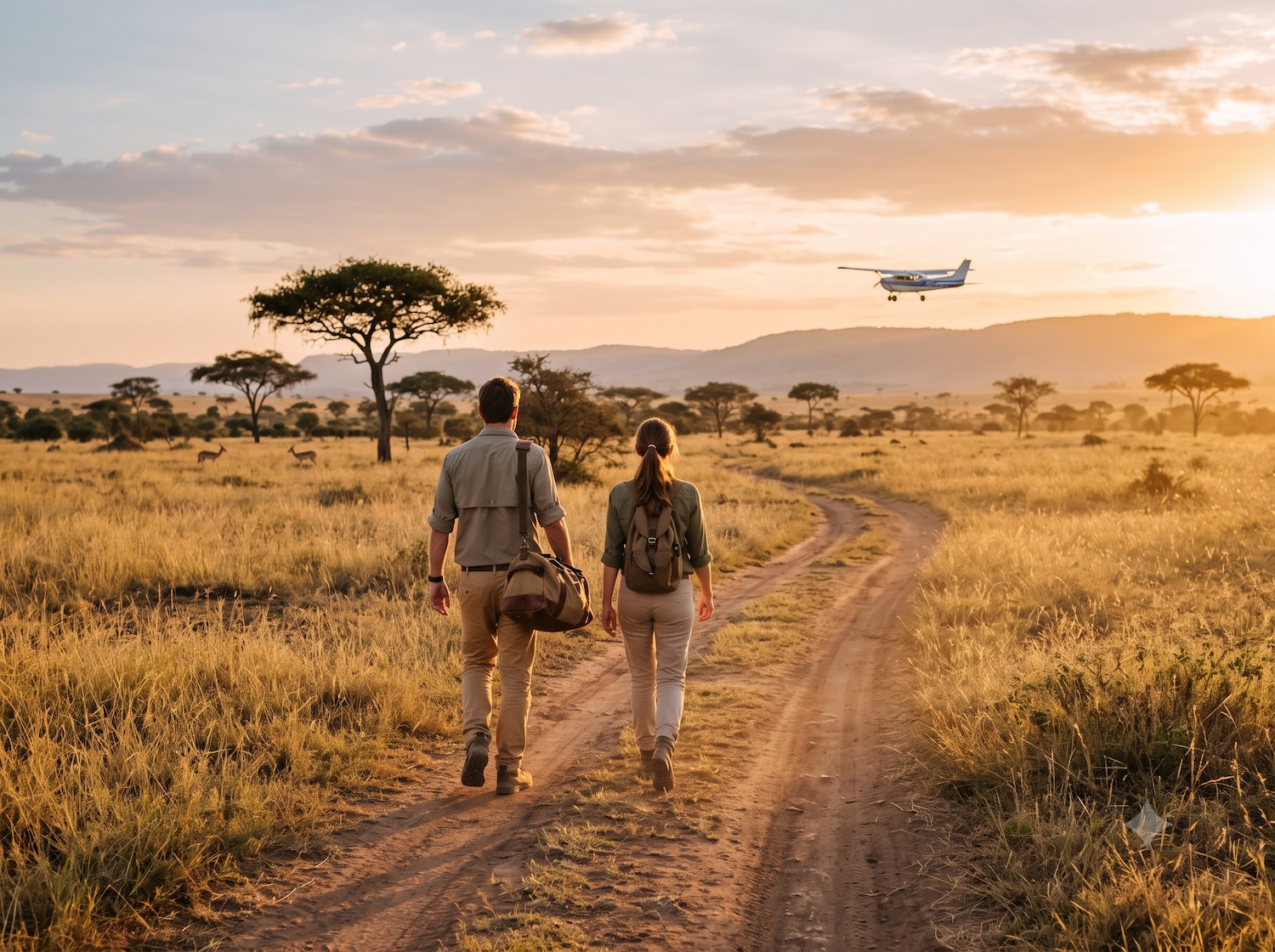
Use one soft-sided bag, not a hard suitcase, because the light aircraft that connect the safari airstrips pack luggage into curved holds that a rigid case will not fit into.
This is the rule that catches people out, so it is worth getting right before you fly.
On weight, the allowance varies with the airline and the specific flight. As a rule, you get around 20 kg (44 lbs) of checked baggage plus 5 kg of hand luggage, but it can be more restrictive depending on the carrier and the flight, so check the exact figure with your airline before you pack.
This is the light plane that takes you between parks, not the intercontinental flight in, and the two have very different rules. If you are still sorting out how you get to Tanzania, I have covered direct flights from Europe and which airport to fly into separately.
What to carry, and how:
- A soft duffel bag as your main luggage, within the weight limit above.
- A daypack of 20 to 25 liters for the vehicle: camera, water, and the layer you just took off.
- A dry bag if you travel in the wet season, to keep electronics and documents safe from a sudden downpour.
- Cash in US dollars for tips and incidentals, in bills dated 2009 or later, since older notes are often refused.
- Documents: passport, visa, the certificate of your mandatory entry insurance with its QR code, your own travel insurance, and any vaccination certificate, kept in your carry-on.
Read also “Vaccinations for Tanzania: What You Need, and When”.
What to pack by season
Tanzania has a dry season and a wet season, and the difference changes what you add rather than the whole list.
The core clothing and gear stay the same year-round; the extras below are what you adjust.
| Dry season (Jun–Oct) | Wet season (Nov–May) | |
|---|---|---|
| Warm layers | Essential, mornings are cold | Still useful, less critical |
| Rain gear | Rarely needed, maybe in October | Waterproof jacket essential, especially Mar–May |
| Dust protection | Important, tracks are very dusty | Less of an issue |
| Insect repellent | Standard amount | Bring more, mosquitoes increase |
| Dry bag | Optional | Recommended for electronics |
The rains rarely wreck a safari.
The long rains from March to May are the heaviest, with April the wettest month almost everywhere, but even then the short rains tend to come as brief afternoon bursts rather than all-day gray.
You plan around them, you do not cancel for them. If you are still choosing your dates, our month-by-month climate guide breaks down what to expect.
A quick packing checklist
Here is the whole list in one place, to pack straight from. The reasoning for each item is in the sections above.
Clothing:
- Neutral-colored shirts, short and long sleeve
- Lightweight quick-dry trousers
- Fleece or light down jacket
- Windproof shell
- Warm hat and thin gloves (Ngorongoro / early starts)
- Scarf or sarong for towns and villages
Footwear and headwear:
- Closed walking shoes
- Sandals
- Wide-brimmed sun hat
Gear:
- Binoculars
- Camera and zoom lens
- Power bank
- Type G (UK) plug adapter
- Headlamp or flashlight
Health and toiletries:
- High-SPF sunscreen
- Sunglasses
- Buff or dust scarf
- Eye drops and wet wipes
- Insect repellent (DEET or picaridin)
- Personal medications
Luggage:
- Soft duffel bag (within the weight limit)
- Daypack, 20 to 25 liters
- Dry bag (wet season)
- US dollars, 2009 or newer
- Passport, visa, entry insurance certificate, your own travel insurance, vaccination certificate
Read also “Tanzania Safety: What the Advisories Say and What Actually Puts Travelers at Risk“
Pack lean and you will be glad of it. Space and weight are limited on the light aircraft, laundry is easy at the lodges, and almost nothing on this list needs a spare. If you forget something small, we can usually sort it out.
Hakuna matata.
Sources
- US Centers for Disease Control and Prevention, Mosquitoes, Ticks, and Other Arthropods (CDC Yellow Book), on recommended repellent ingredients and clothing protection.

