

I get this question in almost every pre-departure email, and it deserves a straight answer.
Malaria in Tanzania is real, but the risk depends far more on where you sleep and the hours you spend outdoors than on the country as a whole. A traveler on the northern circuit and someone working near Lake Victoria are not exposed to the same thing, and the numbers show it.
Risk Areas and Stats
Malaria transmission in Tanzania varies roughly tenfold between regions. The CDC treats every area below 1,800 m (5,906 ft) as carrying risk, which covers almost the whole country, including all the main safari parks. Altitude reduces the risk. It does not remove it.
The most recent national survey, the 2022 Tanzania Demographic and Health Survey and Malaria Indicator Survey, tested children aged 6 to 59 months in every region.
Read also “Tanzania Safety: What the Advisories Say and What Actually Puts Travelers at Risk“.
| Region | Malaria prevalence, children 6 to 59 months |
|---|---|
| Zanzibar (Unguja and Pemba) | 0% |
| Kilimanjaro | 2% |
| Arusha | 3% |
| Manyara | 4% |
| Dar es Salaam | 5% |
| Tanzania, national | 12% |
| Tabora | 18% |
| Kagera | 19% |
| Kigoma | 21% |
That table measures how much malaria circulates among resident children, not your odds of infection on a 10-day trip.
The northern circuit sits at the low end, and here I have to correct something this blog used to say. We wrote that Arusha and Ngorongoro were malaria free.
Arusha sits at 1,400 m, below the CDC threshold, so that was wrong.
A 2024 study in International Maritime Health tested residents of Karatu District, the town most of our guests pass through on the way to Ngorongoro, and found malaria in 7.9% of the 101 people sampled.
That study used PCR, which picks up low-level infections the rapid tests behind the table above would miss. Its authors concluded that travelers to the region should take antimalarial chemoprophylaxis.
That risk holds year round. Transmission rises after the rains but never stops in the dry months.
Zanzibar and the 2024 outbreak
Zanzibar carries the lowest malaria burden in the country, with prevalence around 1% and no cases among young children in the 2022 survey. That record is what made the next part unexpected.
Between November 2023 and March 2024 the archipelago recorded 23,569 confirmed cases in 21 weeks, clustered in southwest Unguja, and 82.6% of them were locally transmitted rather than imported.
A 2025 study by the Ifakara Health Institute and the Zanzibar Malaria Elimination Programme found the pattern holds structurally: local infection persists, now concentrated in school-age children and young adults.
So if you are adding beach days on Zanzibar to your safari, treat the archipelago as low risk, not as somewhere you can stop thinking about mosquitoes.
Preventive Medications for Travelers
The WHO classifies Tanzania as a country where travelers should combine mosquito protection with antimalarial chemoprophylaxis.
Which drug suits you is a medical decision, and it turns on your health history, your age, and whether you are pregnant. Your doctor decides. These are the options the CDC lists for Tanzania in the 2026 edition of its Yellow Book:
- Atovaquone-proguanil. Daily with food, starting 1 to 2 days before arrival. The usual choice for short trips.
- Doxycycline. Daily. Not for pregnancy or children under 8, and it can cause an exaggerated sunburn reaction, which matters when you are out on the plains all day.
- Mefloquine. Weekly, starting at least 2 weeks before arrival. Not suitable for everyone, particularly with a history of psychiatric or seizure disorders.
- Tafenoquine. Loading doses, then weekly. Before you start, you need a G6PD enzyme test, which most travelers have never heard of.
Chloroquine appears on the CDC’s general list but not for Tanzania. Resistance is established here, so it is not an option for this country.
Book the travel clinic appointment early rather than in your last week at home. The G6PD test and the mefloquine lead time both need more runway than people expect.
Strict Bite Prevention
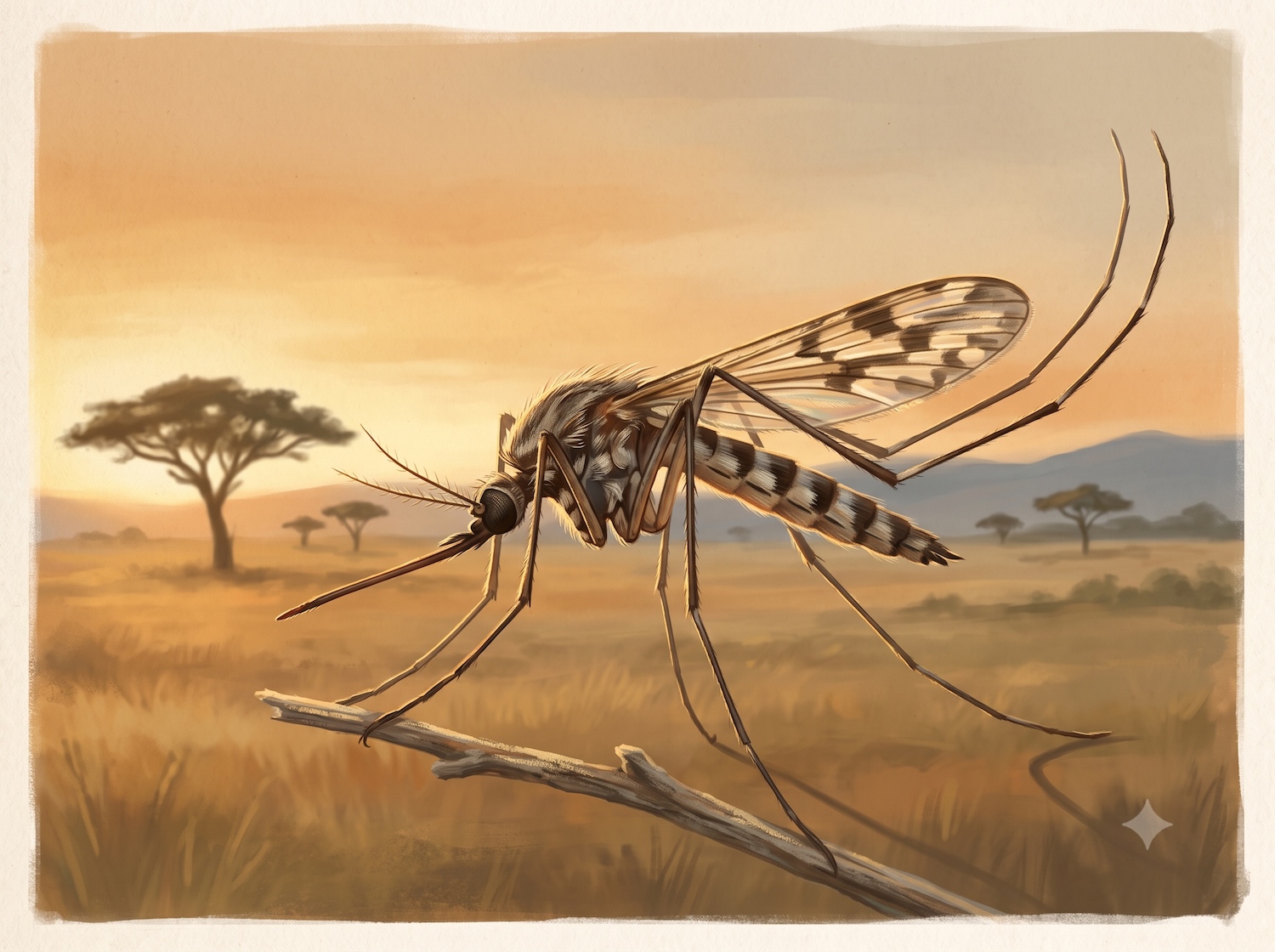
The Anopheles mosquito that transmits malaria bites from dusk to dawn. That puts your exposure in the hours around sunset and overnight, well after the morning game drive is over.
The measures are simple and they work:
- Sleep under the mosquito net, tucked in, every night. Lodges and tented camps all provide one.
- Cover up from late afternoon onward: long sleeves, long pants, closed shoes.
- Apply repellent containing DEET to exposed skin, and reapply after swimming or sweating.
- Keep tent flaps and doors shut after dark, and use the screened areas instead of sitting out in the open at night.
Camps and lodges spray rooms and tents daily, usually while you are still out on the afternoon drive, which is why most guests never notice it happening.
I live in Arusha and I ride most evenings. The mosquitoes are there, and covering up at sunset stopped being a decision for me years ago.
Sunset comes fast this close to the equator, about 30 minutes from golden light to full dark, and that window is what catches visitors out.
In 14 years of organizing safaris, we have never had a guest come back with malaria. I have never had it either, and neither has anyone in my family.
I don’t read that as evidence that the risk is small. I read it as evidence that the nets, the daily spraying, and the long sleeves do their job, and that they only do it when people actually use them.
If You Get a Fever While You Are Here
Tell your guide immediately. Rapid malaria tests are widely available in clinics across Tanzania and getting tested is routine here, not a drama.
Every Savannah Explorers safari includes Arusha Medivac services: a guaranteed air ambulance response if you need medical evacuation, to a hospital in Arusha, Dar es Salaam, Nairobi, or South Africa.
What is guaranteed is the response, not the bill. The cost of the flight and of any hospital treatment falls to you or your insurer, which is why the service only operates for guests who have sent us their travel insurance details. Do that before you fly.
Immediate Post-Travel Care
This is what the old version of this article missed, and it matters more than anything else on this page. Malaria has an incubation period of 7 days or longer, and symptoms can appear up to 3 months after you leave a risk area, occasionally later.
The WHO is blunt about what that means. A fever in a traveler within 3 months of leaving a malaria-risk country is a potential medical emergency and should be investigated urgently. Falciparum malaria can be fatal if treatment is delayed beyond 24 hours after symptoms start.
Two things when you get home:
- If you develop a fever, get tested for malaria the same day. Do not wait to see whether it passes.
- Tell the doctor you have been to Tanzania, and say it first. Outside Africa, malaria is not what a physician looks for in a febrile patient, which is why the CDC instructs clinicians to take a travel history. That history is the one piece of information only you can supply.
This holds even if you took your prophylaxis correctly. No antimalarial is 100% effective.
Common Questions
The short answers, for anyone who scrolled straight to the bottom.
Do I need malaria pills for a Tanzania safari?
The CDC recommends chemoprophylaxis for all areas of Tanzania below 1,800 m, which includes every major park. The choice of drug is your doctor’s call, but the default answer here is yes.
Is there malaria in the Serengeti and Ngorongoro?
Both the Serengeti and the Ngorongoro Conservation Area sit in regions where measured transmission is among the lowest in Tanzania. The peer-reviewed data from Karatu, on the Ngorongoro approach, still supports taking prophylaxis.
What vaccinations do I need for Tanzania?
No vaccination is required to enter Tanzania, with one exception: proof of yellow fever vaccination if you arrive from a country where the disease is endemic, including airport transits of 12 hours or more. There is no malaria vaccine for travelers. Entry requirements are covered in more detail in our guide to “Do You Need a Yellow Fever Vaccine for Tanzania?“.
Read also “Vaccinations for Tanzania: What You Need, and When“.
Sources
Every figure on this page comes from one of the following, with the date of the source given so you can judge how current it is.
- Malaria Information and Prophylaxis, by Country, CDC, reviewed December 2021 and republished May 2024. Altitude threshold and drug resistance for Tanzania. The CDC revises these country risk designations only when a country’s epidemiology changes, and the 1,800 m threshold is confirmed in the 2026 Yellow Book.
- Malaria, CDC Yellow Book 2026 edition, CDC, April 2025. Chemoprophylaxis options and dosing schedules.
- International Travel and Health, Module 3: Malaria, World Health Organization, November 2024. Incubation period, post-travel fever guidance, and the prevention framework.
- 2022 Tanzania Demographic and Health Survey and Malaria Indicator Survey, National Bureau of Statistics and the DHS Program, survey conducted February to July 2022. Regional prevalence data.
- Prevalence of malaria in Arusha Region in the northern Tanzania, International Maritime Health, 2024. Karatu District molecular study.
- The November 2023 to March 2024 malaria epidemic in Zanzibar, Malaria Journal, October 2025. Case counts and share of local transmission.
- Local infections persist despite major gains in Zanzibar, Ifakara Health Institute with Swiss TPH, Tulane University, and ZAMEP, October 2025.
- World Malaria Report 2025, World Health Organization, December 2025. Global figures and drug resistance status.
- Malaria Diagnosis and Testing, CDC, March 2024. Travel history in febrile patients.
- Tanzania International Travel Information, U.S. Department of State, January 2025. Yellow fever entry requirement.

